

 by Rob Bell/Photos by the author except as noted
As I have related in my locomotive articles, World War II had a huge impact on the White Pass & Yukon Route. The line just could not keep up with the demands placed on the railroad by the United States Army to move equipment and material from the port of Skagway north to Whitehorse, Yukon Territory. This equipment and material were for various war-time projects such as the Alaska-Canadian Highway (Alcan) and the CANOL Project (Canadian oil). The WP&YR’s freight car fleet was rolling stock mostly dating from much earlier in the century and was worn out by 1942. On October 1, 1942, the Army leased the White Pass & Yukon Route for the duration of the war. The Army ran the railroad and brought in personnel, “soldier railroaders,” who worked side-by-side with White Pass employees. The Army also set about acquiring locomotives and rolling stock to supplement the White Pass fleet.
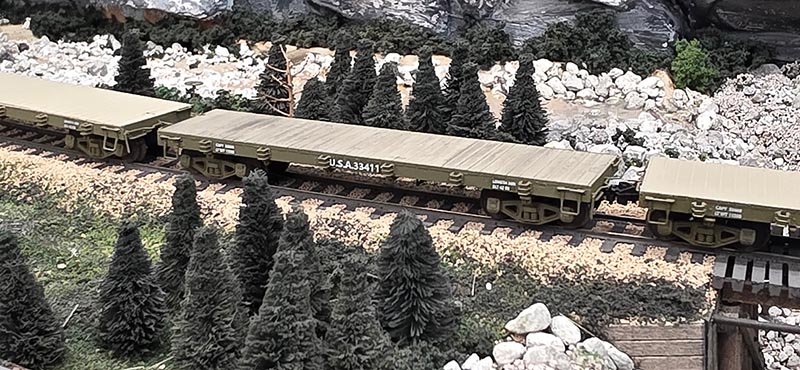
One of the sources for narrow gauge equipment that the Army found was the Colorado & Southern Railway (C&S) in Colorado. The C&S narrow gauge was being slowly torn up and scrapped between 1938 and 1943. The Army contracted with the Chicago Freight Car Parts Company to rebuild 174 cars for use on the WP&YR. Fifty box cars, fifteen refrigerator cars, nine cabooses, and one-hundred flatcars were rebuilt from original box, refrigerator, and coal (gondola) cars. The flats were received in Skagway in June, July, and August 1943. While most were the classic steel underframe, ten of the flatcars had wood underframes and truss rods. The cars all wore olive drab paint and white lettering.
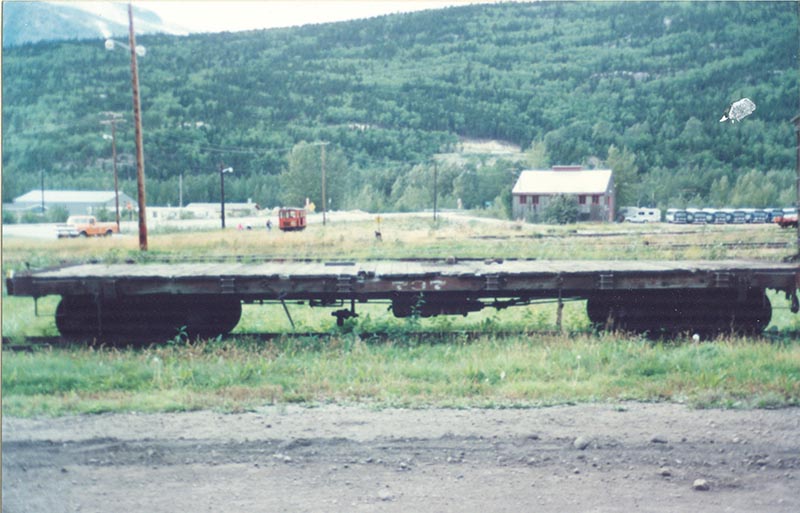
ABOVE: White Pass & Yukon Route 737 was sitting outside of the shops in late-August 1994 when the author photographed it. A steel underframed car originally built in 1910 as a boxcar, the Chicago Freight Car Parts Co. rebuilt it as flatcar 334073 in 1943 for the U.S. Army for service on the WP&YR. The White Pass bought it from the War Assets Administration in 1947. Although not officially retired until 2017, the car was used very little after 1997. Note that it is an oxide red car with only white numbers, no lettering.
In 1946, after the end of WWII, the Army gave the White Pass sixteen steel underframe flatcars and six refrigerator cars as replacements for equipment destroyed during the Army lease. The WP&YR bought forty-eight of the steel underframes flats, thirty-one box, and three cabooses from the War Assets Administration in 1947. After acquisition, the cars wore a typical oxide red (boxcar red) paint and yellow lettering.
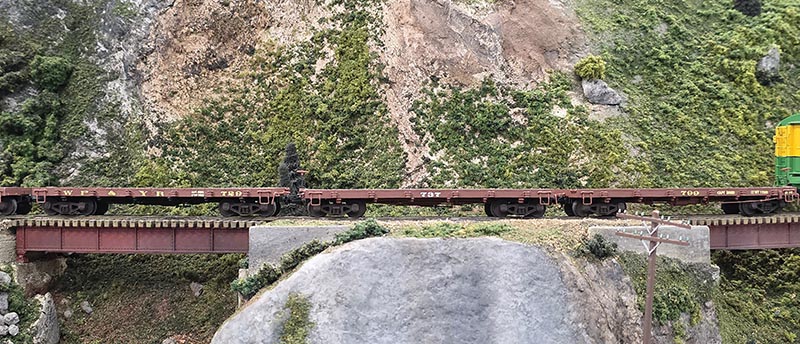
ABOVE: Here are three of my rebuilt MTL steel underframe flatcars after the cars were assembled with the parts provided in the kit and decals applied. They are ready for service on the Hard Ridge Division, but need weathering to reflect the harsh conditions in Alaska and the Yukon. I airbrushed Rust-Oleum Camouflage Dark Earth on the trucks and some underframe parts. The color really looks like weathered iron. Prototype photos were referenced for lettering and showed there was a wide variety in the lettering schemes used on the White Pass flats. I designed the decals and had them printed by Precision Design Company.
In 1955, the line instituted its first container transportation system and needed more flats. Between 1956 and 1961, thirty-four of the boxcars, refrigerator cars, and one caboose were cut down and converted to flatcars by the WP&YR shops. These conversions used the steel Bettendorf frame with new steel side and end sills and wood decks. These were reportedly painted black with white lettering. The reality was that over time, some boxcar red flats got white lettering and some black cars got yellow lettering. It is best to follow prototype photos for reference…
