

 Jeff Livingston/photos as noted
Although not the first railroad in Hawaii, the Oahu Railway and Land Company (OR&L) is by far the best known. Founded by Benjiman F. Dillingham, the railroad was authorized by a bill introduced in the 1888 legislative session “to authorize and promote the construction of steam railroads on the island of Oahu.” Dillingham was named in the bill which would effectively grant him an exclusive franchise to construct a railroad. The bill passed on September 4, 1888, Dillingham’s 44th birthday, and was sent to King Kalkaua for signature, which occurred September 11, 1888. Dillingham boasted to his friends and supporters he would give them a ride on his new railroad one year from the day of its passage on September 4, 1889.
Dillingham, even as founder and promoter of the railroad, was not an officer or director of the OR&L. Those positions fell to “local men of high esteem” who promptly issued a contract to “B.F. Dillingham, Contractor” to build and equip the first 12 miles of railroad. Dillingham had decided early on that the OR&L was to be a three-foot narrow gauge railroad and two Baldwin Locomotive Works 4-4-0 locomotives were ordered through Charles Brewer & Co. These orders were entered by Baldwin on May 9, 1889, completed in July 1889, and shipped to Hawaii. Dillingham also ordered a number of passenger cars and a few freight cars from Carter Brothers of San Francisco.
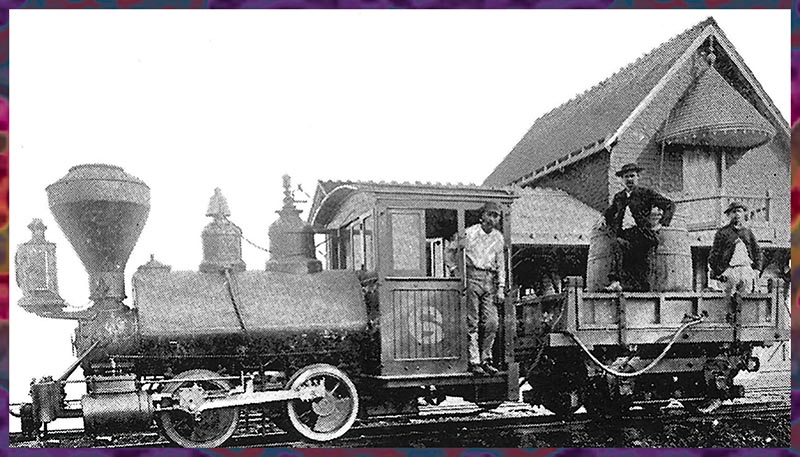
Earliest known photograph of KAUILA No. 6 circa 1890 at the Pearl City station. Note the step pilot, Radley-Hunter stack, square oil headlight, and orientation of the saddle tank. A homemade four-wheel tender with wooden water barrel, built on a dump car frame, was added. — OR&L Archives.
By the end of July 1889, 11 miles of grading was complete and bridge construction was in progress. The bark Deutschland was due to arrive with 800-tons of rail from Bremerhaven at any time, and cars from Carter Brothers were beginning to trickle into Honolulu. The Deutschland arrived on August 10, 1889, and tracklaying commenced as soon as she discharged her cargo.
Dillingham was now under some pressure to fulfill his promise, brashly made a year earlier, to give his friends and supporters a ride on the railroad on his birthday September 4, 1889. The roadbed was ready, track laying was in progress, and some equipment had arrived, but he had no locomotives. He was in luck, however; the Royal Hawaiian Government had ordered a small Baldwin locomotive in March 1889 for use in the Government quarry. According to which story is to be believed, the locomotive was either too big to negotiate the curves in the quarry or the quarry track was so light the locomotive flanges struck the ties. In any case, the locomotive was still in its shipping crates on the Honolulu docks when purchased by Dillingham.
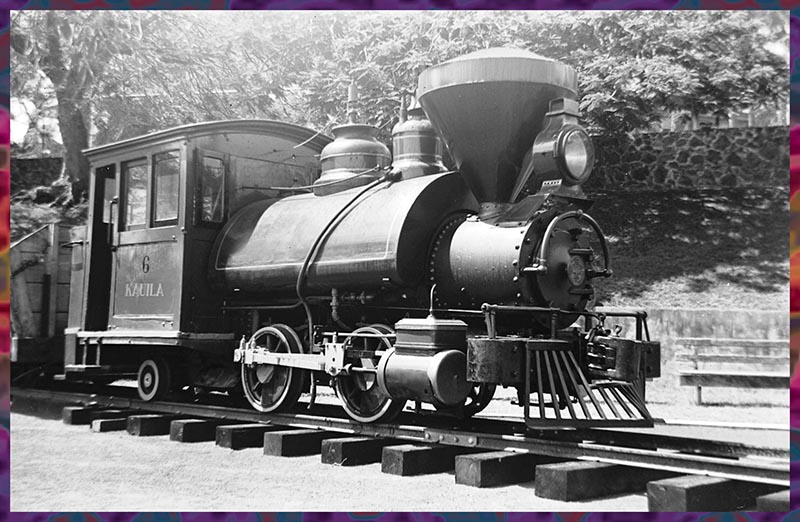
Last operated at the Punahou School Centennial in 1941, the OR&L has added a false Radley-Hunter stack, road pilot and the name “KAUILA.” — Hawaiian Railway Society Collection.
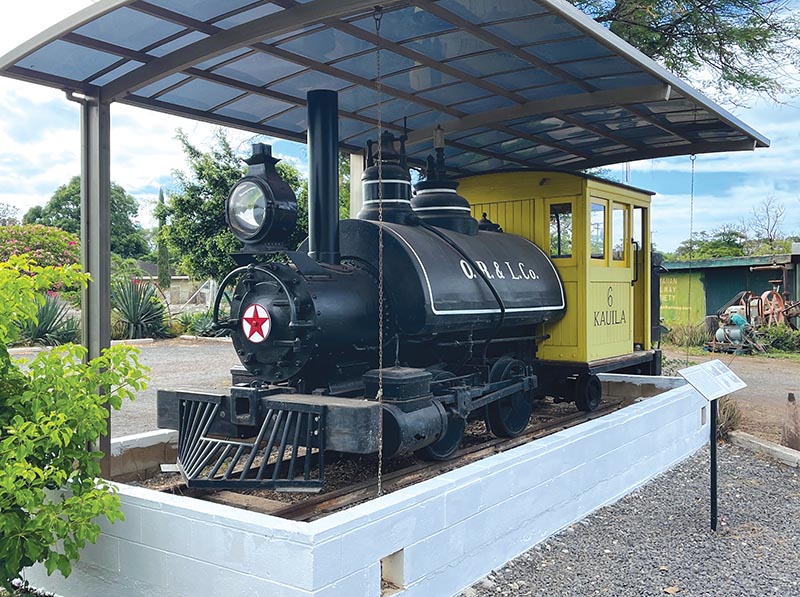
This 0-4-0T, construction number 10028 built May 1889, was named by Dillingham “KAUILA” (lightning) and quickly set up. It was given the number 6 in honor of Dillingham’s daughter, Marion, who was six years old at the time. In fulfillment of his promise, KAUILA—pushing two third class passenger cars (platform cars with awnings, steps and seats)—departed Honolulu at 4pm with 150 passengers onboard for a one-mile journey over unballasted track to the Palama rice plantation. The first car carried the friends and associates of Dillingham and the Officers and Directors of the OR&L, while the second car was filled with native Hawaiians. Engineer Kluegel was at the throttle and a speed of about 10 miles per hour was obtained. Despite this success, one problem was encountered when the train started. KAUILA blew a stack full of damp soot which landed on the first car, giving the occupants and their mostly white clothing a fine sprinkling of black polka dots. A further problem with one of the flues prompted the passengers to detrain at Palama and make their way back to Honolulu via the King Street tramway or other conveyances. Despite this rocky start, KAUILA remained the only operating locomotive on the OR&L until the arrival of the two 4-4-0s. The locomotive was transferred from Dillingham Construction Company (formerly B.F. Dillingham, Contractor) to the OR&L in 1891. It appears that KAUILA became a 0-4-2T with the addition of a rear truck in 1894 per the annual report for that year. No. 6 was overhauled in 1895-1896, receiving saddle tank repairs and a new cab.
Sometime after 1900, the engine was fitted with a new firebox and tubes. In 1912, No. 6 was rebuilt at a cost of $2,000. A handwritten note found in the Dillingham Collection, OR&L Archives at the Bishop Museum dated July 5, 1921, states No. 6 was being used for switching service…