

 Adrian Garner/photos by the author except as noted
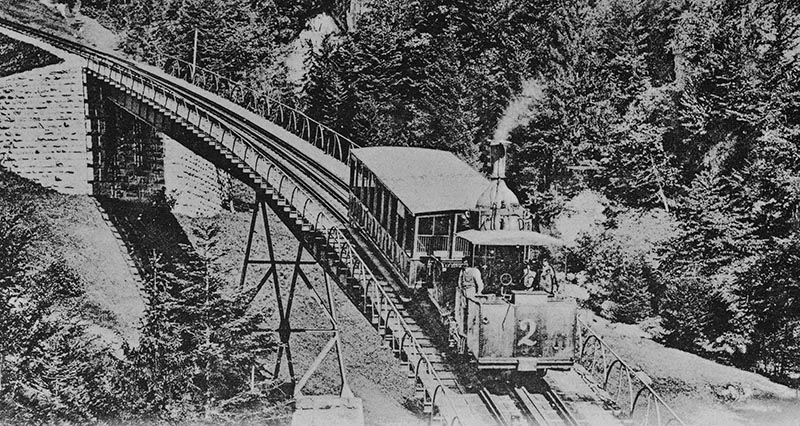
In the second half of the nineteenth century, travel and tourism in Europe was growing rapidly. The mountains of the Swiss and Austrian Alps were favored destinations and relatively safe footpaths and trails were established. Not all were inclined to the vigorous exercise needed and, following the success of the railway up Mount Washington, Swiss engineer Niklaus Riggenbach designed a cog railway to transport travelers to the top of the Rigi mountain near Lucerne in Switzerland. The line was opened on May 21, 1871. As mentioned in Part 1, I became aware of this railway at an impressionable young age in the 1960s. In addition to traveling to the summit with my parents on an electric railcar, I was taken to visit the Verkehrshaus der Schweiz, the Swiss Museum of Transport, in Lucerne. There I saw Rigibahn No. 7 which was one of the first batch of locomotives built for this line. I wished at that time that I could have seen it running.
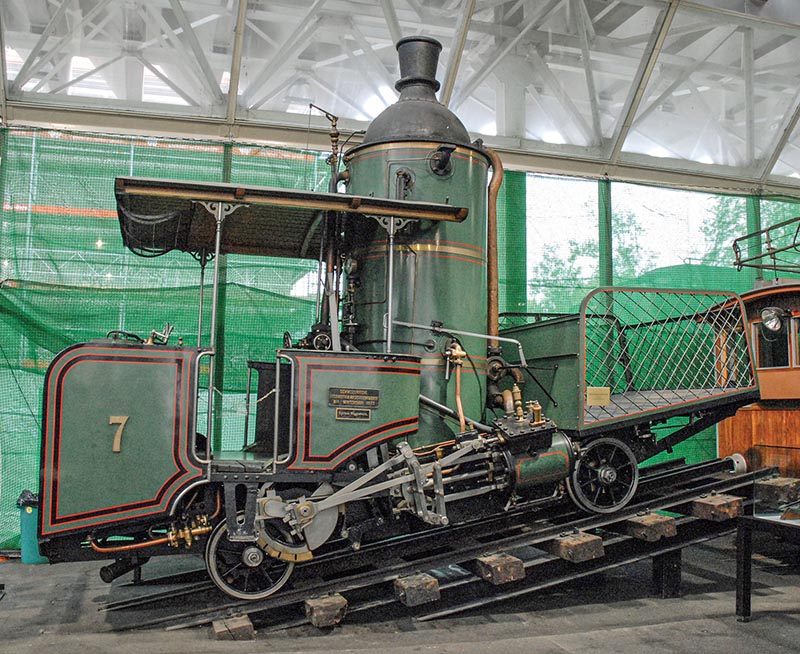
ABOVE: No. 7 in the Verkehrshaus der Schweiz in 2008. — Photo by the author.
More than 30 years later, in 1996, the Rigibahn celebrated its 125th anniversary. To my delight, a year or so before the event the company announced that No. 7 would be restored and operated as part of the festivities. On the few days it operated, it would ascend running light from the base station at the village of Vitznau beside Lake Lucerne to Rigi Staffel, one station below the summit. It would then be attached to a single carriage and make trips back and forth over this upper section. Even better, up to six people could book to travel in the luggage basket on its three-hour ascent from Vitznau. This ascent would be slow due to the relatively slow speed of this locomotive, the need to replenish water at Rigi Kaltbad, and because the train had to be held on sidings to allow normal traffic railcars to pass.
I booked immediately. On the day I traveled, the weather was perfect and it was probably the most memorable rail journey I have ever made. I knew I had to make a model, but somehow never got around to it. Twenty-five years later, in 2021, the line celebrated its 150th anniversary, but events were dampened by the ongoing impact of Covid. Nonetheless, No. 7, which had been returned to the museum after the 1976 celebrations, was brought out of retirement again and, luckily, a window opened up between the lockdowns in the UK and Europe, enabling me to see No. 7 in operation again.
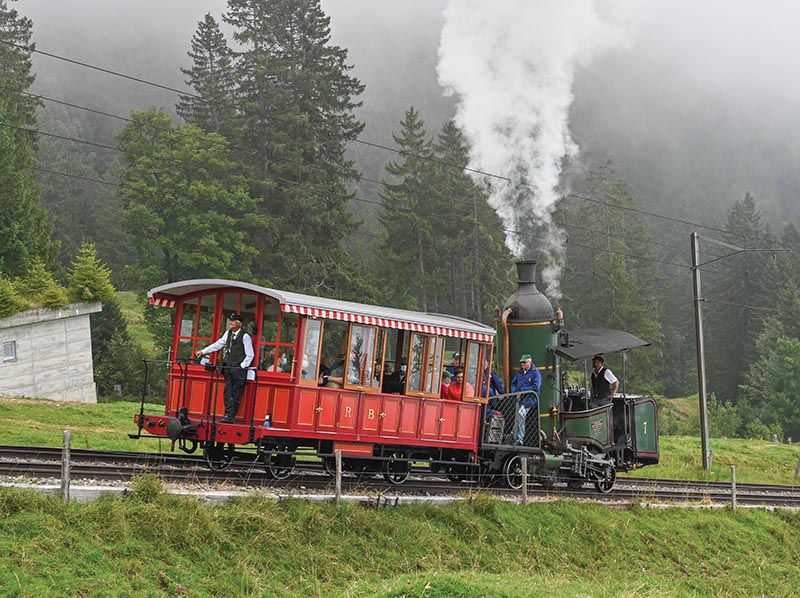
ABOVE: No. 7 rests at Rigi Kulm. — Photo by the author.
This time I will get around to making a model and I am now able to share some of the drawings I have made. The original drawings by the locomotive builder Schweizerische Lokomotiv und Maschinenfabrik, Winterthur, still exist and my drawings are based on copies plus photographs of the restored No. 7…