

 Rob Bell/photos by the author except as noted
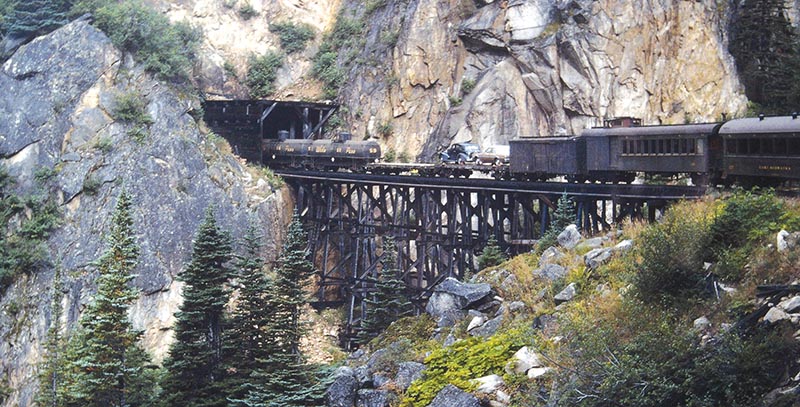
What is “auto-baggage”? It is not a self-loading baggage-express car. Auto-baggage is the term the White Pass & Yukon Route employees used for cars, trucks, campers, and even tour buses that were loaded on their narrow gauge flatcars. Prior to the 1980s, the only way to get to Whitehorse with a car or truck was either the 1500-mile Alcan Highway or the WP&YR’s railroad. You might ask: How did someone get their vehicle to Skagway in order to get on the train to Whitehorse? The answer was either a ferry or a ship up the Inside Passage from Washington or Vancouver.
While I haven’t been able to find a definitive answer for when the White Pass started hauling automobiles? I have seen a photo that dates to the late teens or early 1920s where an airplane was being loaded onto a flatcar at the wharf. Many loads of various vehicles types from Jeeps to bulldozers were hauled by the railway during WWII. Certainly by the mid- to late 1950s, auto-baggage was a common sight on the White Pass. Prototype photos of Skagway, Whitehorse, and of the loaded auto-baggage hauled by the White Pass show a lot of four-door cars, vans, pickup trucks with campers, camper trailers, and motor homes.
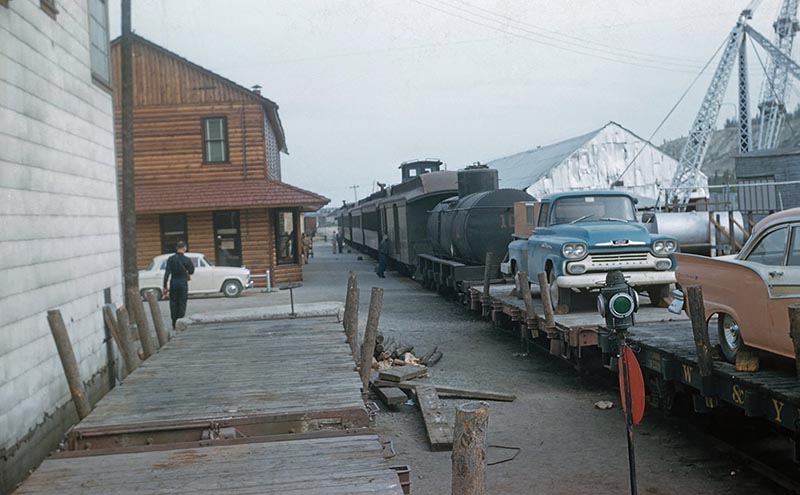
A southbound WP&YR mixed train prepares to leave the Whitehorse, Yukon Territory, station. The date of this photo is given as 1958, but the author suspects it actually was taken circa 1960 or so. The 1958 Chevrolet Apache loaded on the flatcar has a fair amount of wear on the bed side-rails for a new truck. The tail end of a well-kept 1957 Ford Fairlane is on the next car forward. Interestingly, the author was able to identify the small white car next to the depot as a 1957 or 1958 Austin A55 Cambrian (a North American export version of the Cambridge). This again, points to a photography date later than 1958. — Unknown photographer, collection of Boerries Burkhardt.
The WP&YR wasn’t the first or the only narrow gauge line to haul vehicles. The East Tennessee & Western North Carolina built three special purpose cars for moving semi trailers in 1935. There was also an article by Dr. Gregg Condon in the Mar/Apr 2023 GAZETTE about modeling a flatcar fitted with canvas sides and roof for transporting autos on the D&RG. Beyond these, what do vehicles have to do with narrow gauge modeling anyway?
Vehicles are most important for setting the era modeled. If your layout has only horse and buggies, the timeframe indicated is likely to be pre-1900. Horse-drawn wagons and a few early autos might indicate a time period of about 1905-1915. In some places, horse-drawn milk wagons lasted years after everything else was motorized, so there is an exception there. If you are modeling Durango in 1935, you certainly don’t want a 1940 Ford coupe sitting at the depot. Which brings up another point: if the era modeled is 1935, you only want one 1935 vehicle present unless you are modeling a dealership. Generally speaking, the majority of vehicles in any one given year will be several years older. Few people could (or can) afford a brand-new car or truck every year.
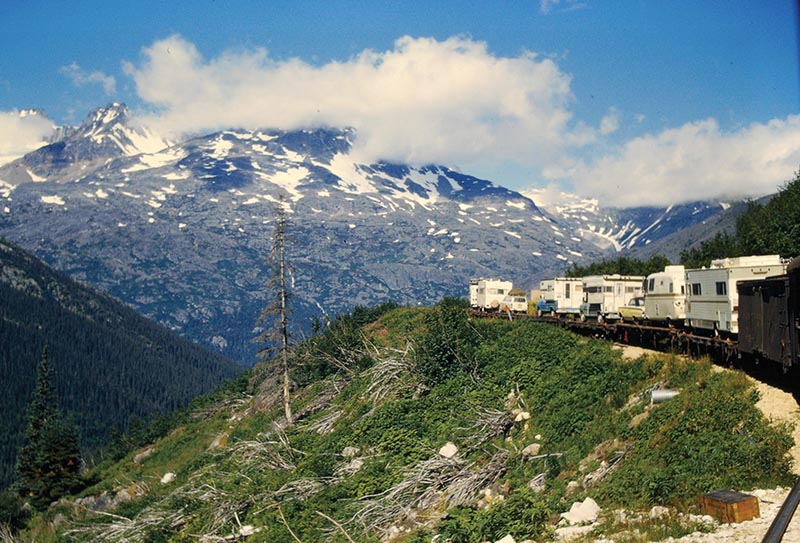
Auto-baggage on a northbound White Pass & Yukon Route mixed train circa 1971. There are three pickup truck campers, three motor homes, and two automobiles loaded on the narrow gauge flatcars. What other North American narrow gauge regularly hauled Winnebago motor homes? (Answer: none, to the author’s knowledge.) — Unknown photographer, collection of the author.
As a kid growing up in the 1970s, I remember the muscle cars that were around from the late 1960s. Chevelles, Chargers, Mustangs, GTOs, Camaros, Firebirds, and Javelins were all dream cars of us kids whose heart rate jumped when one pulled up next to Mom’s Impala at a red light. Was my young interest in cars influenced by Matchbox and Hot Wheels? Probably. As I approached my teenage years I drooled over issues of Hot Rod magazine, but since I didn’t have a car to mess with, I built model trains. All of the cars in the magazines were two-door dreams that didn’t look like what was in the parking lot at the local shopping center. While I was in the U.S. Navy in the mid-1980s, I had an old Willys Jeep and a couple of mid-1960s Mustangs. Several of my shipmates had classic muscle cars as well.
What I remember seeing as a kid were mostly four-door grocery-getters, and station wagons. Why is this important to our modeling? Variety brings a sense of realism. I suspect that many of the narrow gaugers out there model the 1920 or 1930 timeframe, so they don’t really need to worry about the four-door cars as much. By the late 1930s however, four-doors were becoming more common. If your 1955-era depot parking lot or Main Street is full of two-door Chevy Bel-airs, you might be missing out on some reality points. Toss in a bunch of four-door cars and the scene will be much more believable. The same goes for the exotic cars like Cobra 427s, Ferraris, and Lamborghinis; these cars were not and are not common. Should they be on our layouts just because we wanted a real one? That is ultimately up to the layout owner to consider…