

 Bob Staat/photos by the author
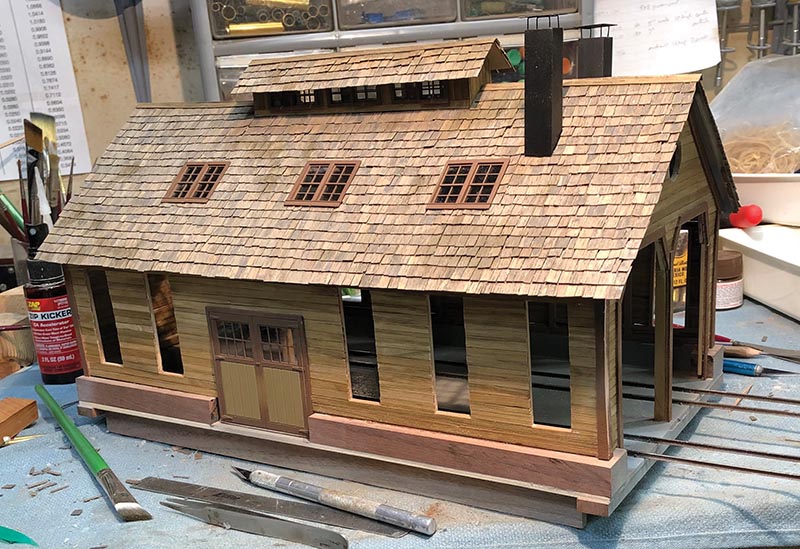
When we visit a fellow modeler’s layout, most of us first notice the locomotive running. “What nice weathering and the sound coming from the smoke-box speaker is very realistic.” We move on to the scenery and comment on the structures, but seldom do we really see the most visible aspect of the buildings, the roofs. Roofs in the prime of the narrow gauge era were either tar paper or wooden shingles (shakes). Tar paper is easily modeled, but shingles less so. Most kits have some sort of shingle material, possibly a printed sheet or a roll of paper shingles. There are modelers who can weather them to look acceptable, but what is missing is texture.
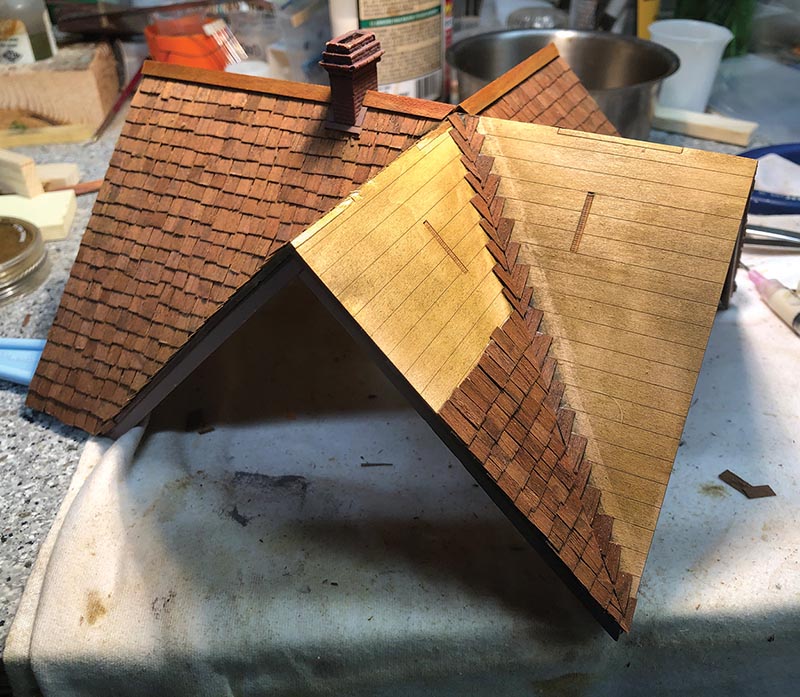
The author prefers using walnut and cedar for his shingles.
In the real world, shingles were cut by hand, usually from cedar or pine trees. Logs of 18- to 24-inches in diameter were cut to a length of 18 inches. and then progressively split with a froe, which is a long, flat blade. In use, the blade is positioned on the center of the log and struck with a wooden mallet. The process is repeated going around the log until it is split into 20-30 rough shingles varying in thickness up to 3/4-inch. The shingles are then trimmed with a small hatchet. While the length is fairly constant, the width is quite variable. Once the shingles are nailed in place, nature takes over resulting in some getting loose from wind, some warping, and general aging. Obviously, this was labor intensive and in the early 1900s, asphalt shingles were invented and by 1940, they had supplanted wooden shingles.
My goal was to make realistic shingle roofs with texture for my model structures. That means the shingle roofs will have a 3-D appearance with some irregularities and each shingle will have a unique width, grain and color. The only way I know to achieve this is by using individual shingles. The idea for using individual shingles came from an article in the November, 1969 Model Railroader which described some aspects of the approach.
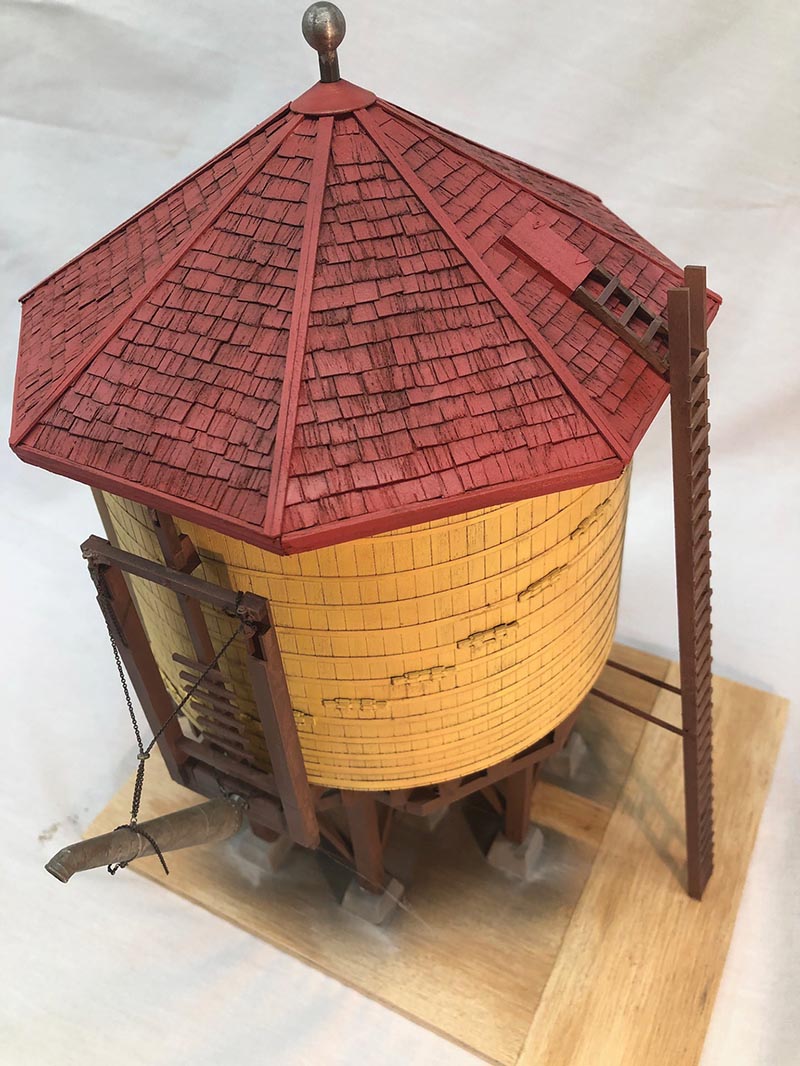
To make shingles for an O scale structure, I have used both cedar and walnut woods. For the cedar, I did a search for Spanish cedar cigar humidor liners and found many available, with most being 0.018˝ to 0.020˝ in thickness. This comes out about right for O scale. I did fi nd a source who supplied 0.010˝-thick cedar, good for HO. The walnut I used comes as 0.020˝ veneer stock. The advantage to cedar is it is soft and cuts easily with a hobby knife, but sometimes the shingles split. Walnut is harder, but still can be cut with a knife; however, it does not have as much variation or character as cedar.
The process of making shingles is straightforward; take the wood sheets (perhaps three deep for cedar) and tape the last 1/8˝ together on both ends. Mark the tape every 3/16˝ (9 scale inches) on both ends. For O scale, I use an S scale rule and mark every foot. Cut the wood, but don’t cut through the tape, as you need to keep the strips in line. Once you have sliced up the sheets, take about 3 slices, and using a razor blade chop-ping cutter with a stop set at 3/8˝, start cutting. The taped end keeps the wood aligned as you chop. But how many do you need? A rough estimate can be made by figuring the square inches of the roof and then multiplying by 1.7. This will give you an idea of how many sheets to cut.
With your pile of shingles, it is time to decide the look you want…